

[Expertise]
AI in store: what retail teams really expect from it
Only 31% of retail employees perceive a positive impact from AI. Expected in-store uses and the place of people, according to the RMS Retail Index™ 2026.

According to the RMS Retail Index™ 2026, only 31% of retail employees currently perceive a positive impact of artificial intelligence on their day-to-day work. What teams mainly expect from it is time given back to the client relationship, which clients want to remain human: according to the Ipsos BVA Customer Service Observatory 2025, cited in the survey, 90% prefer a human advisor to AI. For RMS (Retail Management Services), an in-store AI project succeeds when it starts from frontline pain points, not from the technology.
AI in store: an impact still barely felt
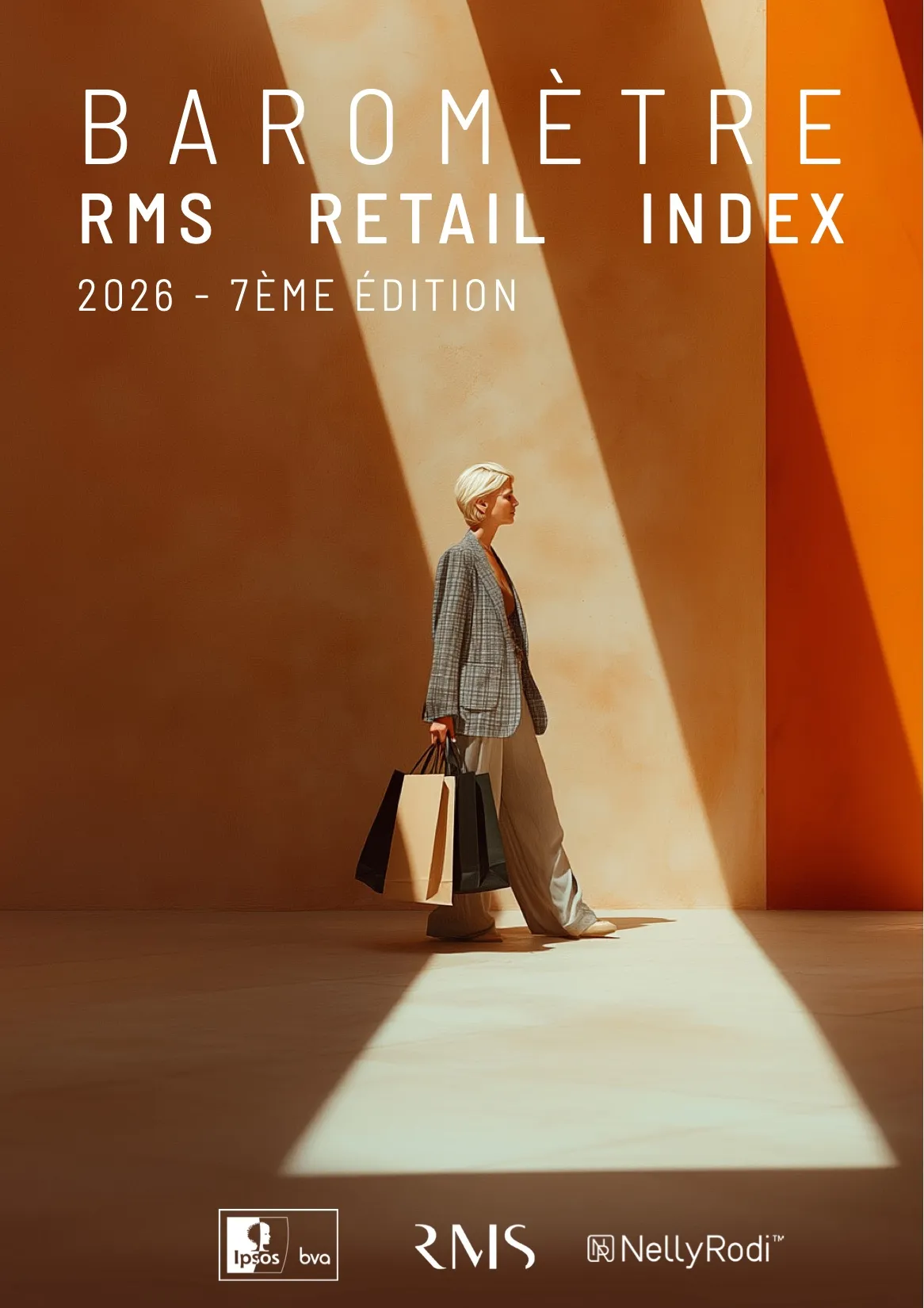
The RMS Retail Index™ 2026, conducted with Ipsos BVA and NellyRodi among 1,485 participants from 105 brands, asks a simple question: “Do you feel that artificial intelligence has a positive impact on your day-to-day work?” According to the survey, 31% answer yes and 69% no.
The study describes an integration that is still slow, both in stores and in interactions with management or head office. One respondent’s comment sums up the mood: “AI isn’t an issue yet, but we’re going to have to adapt to it!” The survey also identifies a new generation of constraints: having to write prompts to communicate with AI weighs on a majority of people working in retail.
The study places AI within a broader transformation of the profession: retail professionals must become ever more versatile, adapt to new processes and absorb the arrival of AI, while 53% of RMS Retail Index™ 2026 respondents already consider their pay insufficient. A poorly supported roll-out therefore risks being experienced as one more demand rather than as a help.
Three uses teams expect
Although only a third of respondents perceive a positive impact, the reactions gathered by the RMS Retail Index™ 2026 point to three expected benefits.
Freeing up time for the client
The first use: simplifying and speeding up processes to spend more time with clients. The need is real: according to the survey, among the 825 respondents asked what weighs on their roles, 29% say they are held back by administration and procedures, and 19% lack the time to carry out their role properly. Ipsos BVA cites the automation of administrative tasks among the possible contributions of AI.
Personalising the relationship through data
The second use: making data extraction easier in order to personalise advice. According to the RMS Retail Index™ 2026, 44% of respondents cite a personalised relationship with their clients as a source of happiness at work, but 12% say they do not have the tools to provide high-quality client follow-up.
Speaking each client’s language
The third use: creating new interactions with non-French-speaking clients, who are delighted to be understood and to converse in their own language. According to the survey, 12% of respondents say they face language and cultural barriers with some clients. Real-time translation is among the contributions cited by Ipsos BVA.
What AI will not replace: the human relationship
AI does not replace what gives a sales associate their value. According to the RMS Retail Index™ 2026, 70% of sales associates say that seeing their clients satisfied is what makes them happiest, and the quality of the client relationship is the third lever of team well-being (42%). On the client side, the Ipsos BVA Customer Service Observatory 2025, cited in the survey, indicates that 90% prefer a human advisor to AI or another technology.
Vincent Grégoire, Consumer Trends & Insights Director at NellyRodi, puts it this way in the survey: faced with the power of new technologies, “the human relationship will make all the difference”, provided it is sincere and authentic. The 44th Rencontres RMS reached the same conclusion: in the face of AI, automation and omnichannel transformation, the human relationship remains the real differentiating factor. The survey’s conclusion points the same way: in the age of AI, building connections matters more than ever in retail.
Making AI work in retail: start from frontline pain points
For AI to move beyond the 31% perceived impact measured by the RMS Retail Index™ 2026, it must respond to concrete difficulties. That is the thinking behind RMS’s AI transformation service, led by Antoine Daumas, Managing Partner at RMS, and Tony Infantino, CEO of Metagora, who combine technological expertise with an understanding of retail professions. It unfolds in three stages:
- Familiarisation: executive committee workshops, an overview of AI uses in retail, challenges and risks, applied prompting
- Roadmap: mapping use cases (client personalisation, real-time translation, data extraction, head office productivity), then prioritising them by impact and feasibility
- Roll-out: choice of solutions, in-store pilots, team training and measurement of productivity gains
“We worked on concrete uses of AI, built into our tools and our daily routines, to address difficulties identified beforehand,” says Sandrine Couillet, International Retail Director at Vanessa Bruno.
AI only takes effect on clear processes: simplifying procedures also calls for work on retail SOPs and tools. It is already serving training: in our client relationship programmes, conversational AI helps teams embed what they have learnt.
AI in service of connection, not in its place
The subject is not new for RMS: the 42nd edition of the Rencontres RMS, on 11 June 2025, was already examining the impact of AI on retail, recruitment and training. The figures from the RMS Retail Index™ confirm that adoption still lies ahead and that it will be decided on the shop floor.
The objective to set is simple: every use of AI should give teams time back for listening and advising, rather than adding another layer of tools. To identify your priority use cases and bring your Executive & Board members on board, explore our AI transformation support or contact our experts.